
Troubleshooting Bubbles, Pinholes, Tackiness and Delamination
Use the timing and location of defects to investigate substrate moisture, entrained air, mixing-ratio errors and failures between coats.
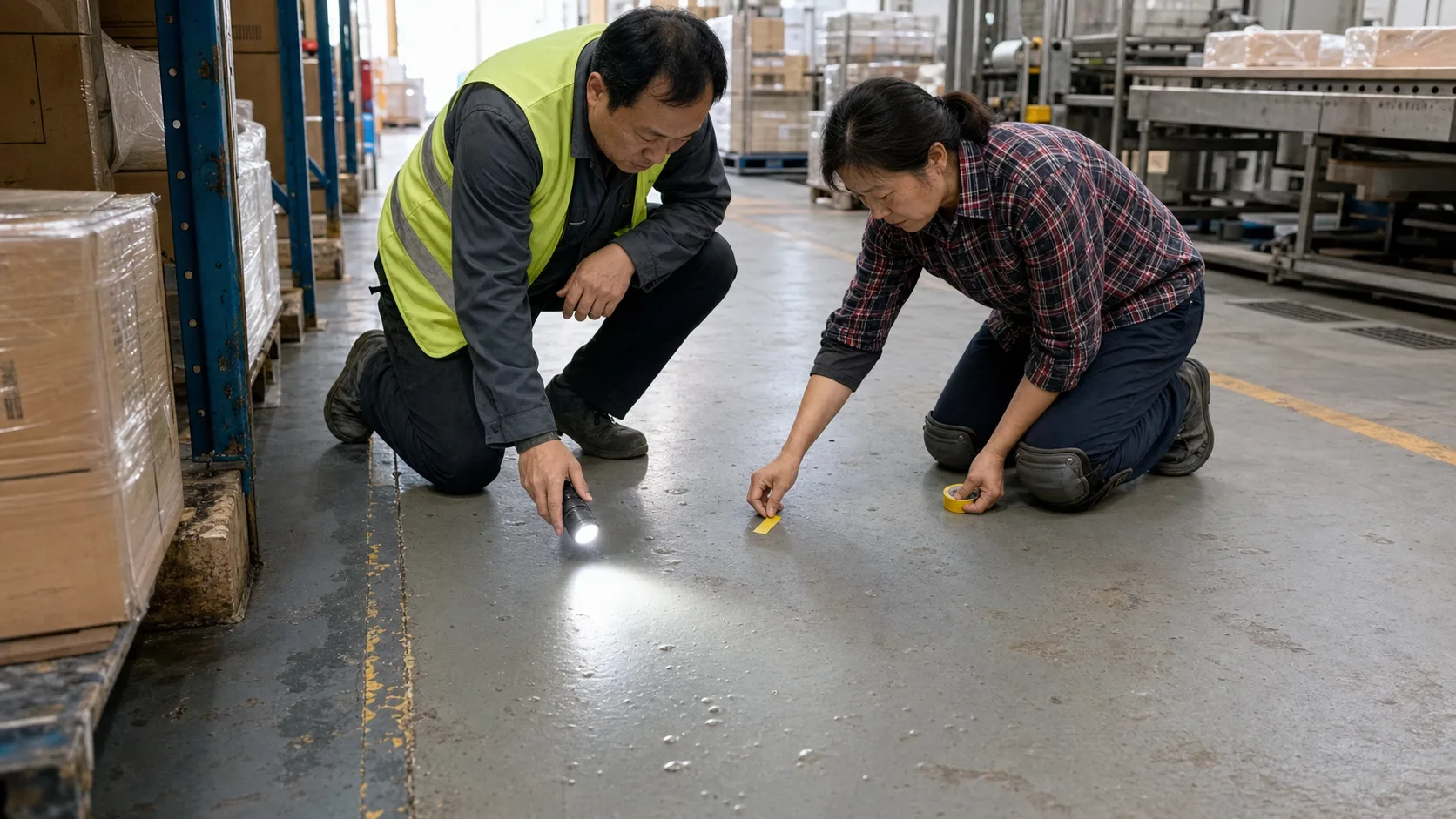
Two people examining cracks and coating defects on a floor
Bubbles and Pinholes
Bubbles commonly relate to substrate moisture, pore outgassing, solar heating, entrained mixing air or an overly thick coat. Pinholes may also result from inadequate primer sealing. Cut through representative defects to identify the layer where they originated.
Peaks and surface pollution
Oil, silicone contamination, dust and residues on tools can cause local surface-tension differences. Extend cleaning and abrasion beyond the defect during rework; do not simply cover it with new material.
Tackiness and failure to cure
First check the A/B ratio, weighing records, mixing uniformity, material temperature, application conditions and batch. Do not add water or arbitrary amounts of solvent to reuse material that has thickened or exceeded its pot life.
Skinning and decorating
Check substrate strength and moisture, primer suitability and the intercoat recoat window. Remove failed material back to a sound interface, rebuild the compatible layers and verify adhesion.
Create diagnostic pathways with defective features
Start diagnosis by recording when and where defects appeared, which layer is affected and their distribution. Dense small bubbles during application often involve entrained air, substrate outgassing or high temperature. Blisters developing in sunny areas after cure may involve vapor pressure. Delamination confined to lap edges calls for checks of the recoat window and contamination. Build evidence from photographs, area maps, batch numbers, mixing times, temperature, humidity and substrate condition rather than relying on assumptions. Cut open defects when needed to inspect their origin and internal condition.
Pinholes, craters and bubbles can look similar but have different causes. Pinholes may remain after gas escapes without leveling; craters often result from oil, silicone or surface-tension differences; bubbles may retain an intact wall. Inspect size, edges, moisture and contamination, and correlate defects with application direction, mixing batches and repaired substrate areas. A thick covering coat may reproduce defects or trap moisture and uncured material.
Fabrication, environmental and construction factors
For tackiness or softening, first check the A/B ratio, scales, component premixing, mixing time and unmixed material at container walls. A visually uniform mixture does not prove the reaction ratio is correct; estimating volumes by eye is particularly error-prone. Material beyond its pot life thickens and loses flow and must not be restored with water or solvent. Low temperature, large temperature differences between components and localized poor mixing also cause uneven cure. Keep weighing and application-area records for every mix to distinguish an isolated mix, a batch issue and a systematic problem.
Assess air and substrate temperatures, humidity, dew-point margin, wind and solar heating together. Sudden heating of a cold substrate can accelerate outgassing; nighttime cooling can cause condensation. Strong winds can cause rapid solvent loss or deposit dust. Excessive thickness, repeated rolling, high-speed mixing and wet tools can also create defects. Use a trial area to confirm roller type, trowel notch and consumption per coat. Stop using a mix if its condition changes markedly, and replace it with fresh material.
Principles of restoration and prevention of closed loops
Extend repairs beyond visible defects to a sound, dry and clean boundary. Remove uncured material completely, clean contamination by a compatible method, then abrade and vacuum. Fill deep local depressions in layers and feather recoat edges. Resolve continuing moisture or active structural movement first. Retest against the original acceptance criteria; color coverage alone is insufficient.
Turn identified causes into site checks. Substrate outgassing may require sealing primers and control of rising temperatures; ratio-related tackiness calls for calibrated scales and independent checking; intercoat contamination calls for area timing records and precoat inspection. Use actual sample panels in crew briefings to show acceptable and unacceptable results, and track recurring defects by type and area.
Project landing and risk review
Before work begins, the project lead should review site conditions with the designer, material supplier, applicator and owner, converting drawing requirements into an actionable area checklist. Include substrate type and condition, coating layers and thicknesses, details, material batches, mixing quantities, tools, crew responsibilities, environmental controls, recoat times and return-to-service conditions. Coordinate other trades, temporary power, ventilation, fire precautions and protection of completed work so that welding, cutting, dust and equipment installation do not interfere with coating. Inspect the first completed area and compare consumption and cure with the trial area before continuing at scale.
Use inspection hold points throughout the work instead of waiting until all surfaces are covered. Inspect and retain photographs and data after substrate preparation, primer sealing, defect repair, reinforcement of critical details and before final handover. If material condition, environmental limits, batch changes or widespread defects raise concerns, isolate the area, retain samples and records, and obtain a technical assessment. Every rework record should identify the failed interface, repair area, materials and retest results. Trial areas, witnessed process checks, traceable records and verified repairs help translate laboratory performance into reliable field performance.