
How to select C1420, C1520, C1330, C1524 and C2850
Select resin grades by comparing viscosity, reaction speed, hardness, flexibility, compatibility and the intended application method, rather than speed alone.
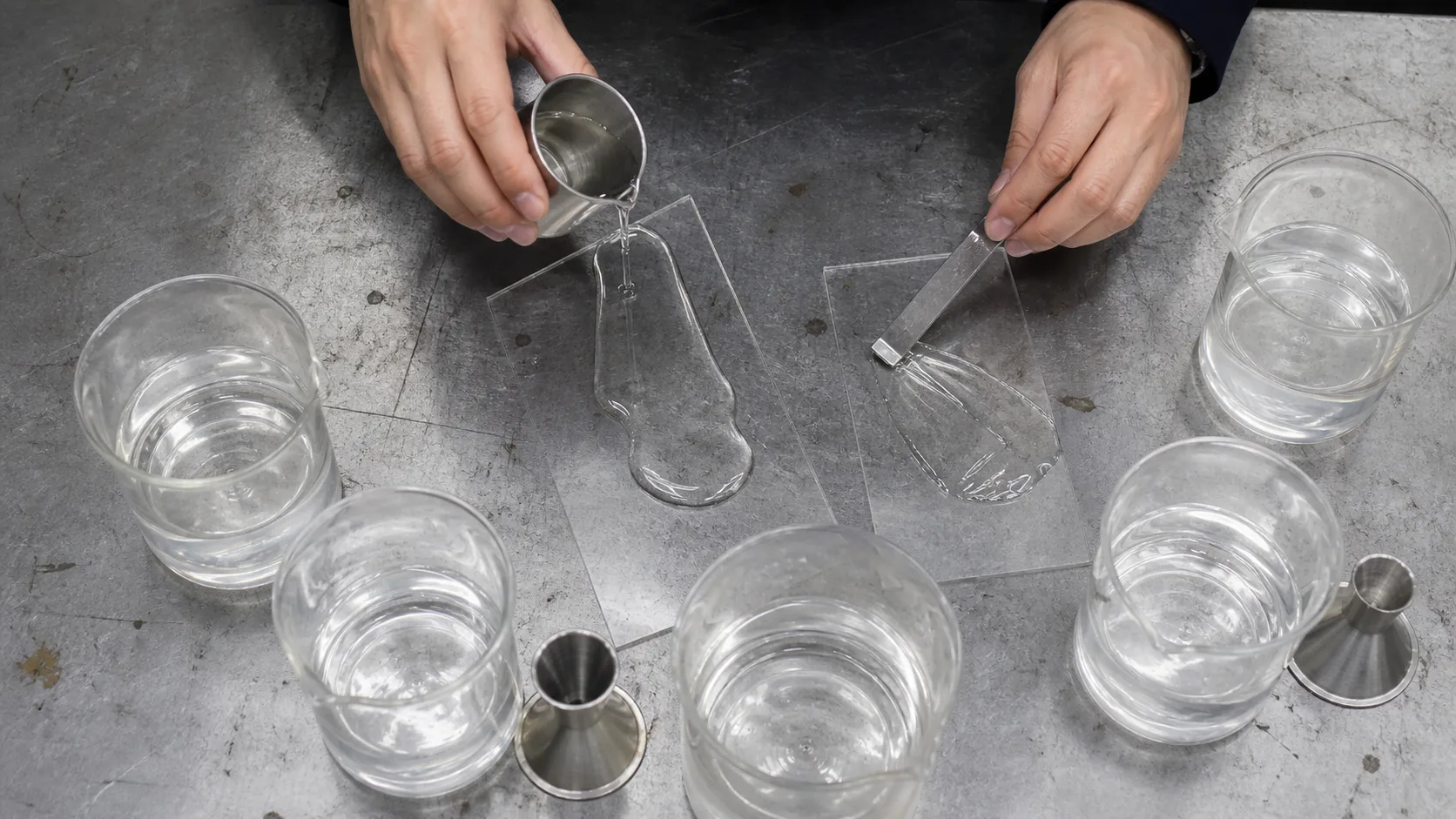
Different clear resin samples being compared on glass panels
Let's get the conditions straight.
Select the resin from the end use: topcoats emphasize weatherability, leveling and appearance; intermediate coats emphasize filling, film build and intercoat adhesion; waterproofing emphasizes flexibility, crack movement and water resistance; industrial protection requires consideration of chemicals, thickness and recoating. A universal grade cannot reliably cover every service condition.
Define the application method, wet-film thickness per coat, ambient temperature, acceptable pot life and reopening time. The same resin may differ substantially in exotherm, bubble release and surface condition between a thin sprayed film and a thick troweled layer.
Compare parameters rather than model only
Evaluate C1420, C1520, C1330, C1524 and C2850 using the supplier's current TDS, samples and batch data. Compare solids content, viscosity, color, amine equivalent weight, functionality, recommended hardener and intended uses. Do not infer chemical structure or final performance from grade numbers.
Add a measured-in-target-formulation column to the selection table. Record mixed viscosity, pot life, defoaming, leveling, hardness development and appearance after adding pigments, fillers and additives. Strong neat-resin data do not guarantee the same advantages in a complex formulation.
Single-resin and resin-blend approaches
For fast turnaround, a faster-reacting main resin may be suitable, but allow enough time for mixing, transfer and rolling. For large manual applications, start with a longer-pot-life resin and adjust early cure by blending. Blending aims to achieve balance, rather than simply mixing two grades in equal amounts by habit.
Use at least three blend levels while holding the NCO/NH equivalent ratio, pigment-to-binder ratio and additive dosage constant. Compare time-viscosity curves, touch-dry time, hardness development and mechanical data to isolate the effect of resin proportion from other variables.
Distribution performance by coating layer
Primers emphasize penetration, wetting and interface reactions; intermediate coats require load support, filling and workability; topcoats emphasize weathering, appearance and cleanability. Different resin combinations can be used within one system, but intercoat compatibility and recoat windows must be verified. Do not simply stack materials with the strongest individual properties.
For flexible substrates or areas with large outdoor temperature swings, control overall modulus and retain movement capability. Heavy-duty floors require a balance of hardness, toughness and impact resistance; high hardness does not replace structural design.
The confirmation step for small to medium test
Begin with laboratory screening at 200-500 g to check mixing, reaction speed and film appearance. Proceed to kilogram-scale trials to assess exotherm, filtration, filling and storage stability. Finally, apply a small area on the actual substrate and record tools, consumption, temperature, humidity and real return-to-service time.
Reconfirm critical parameters after any raw-material substitution. Changes to hardeners, catalytic ingredients, solvents or highly absorbent pigments and fillers may invalidate previous pot-life and appearance conclusions.