
Polyaspartic Resins: Structure, Reactions & Performance
Understand how the secondary-amine structure of polyaspartic esters reacts with aliphatic isocyanates, and how this relates to high solids, weather resistance and adjustable working time.
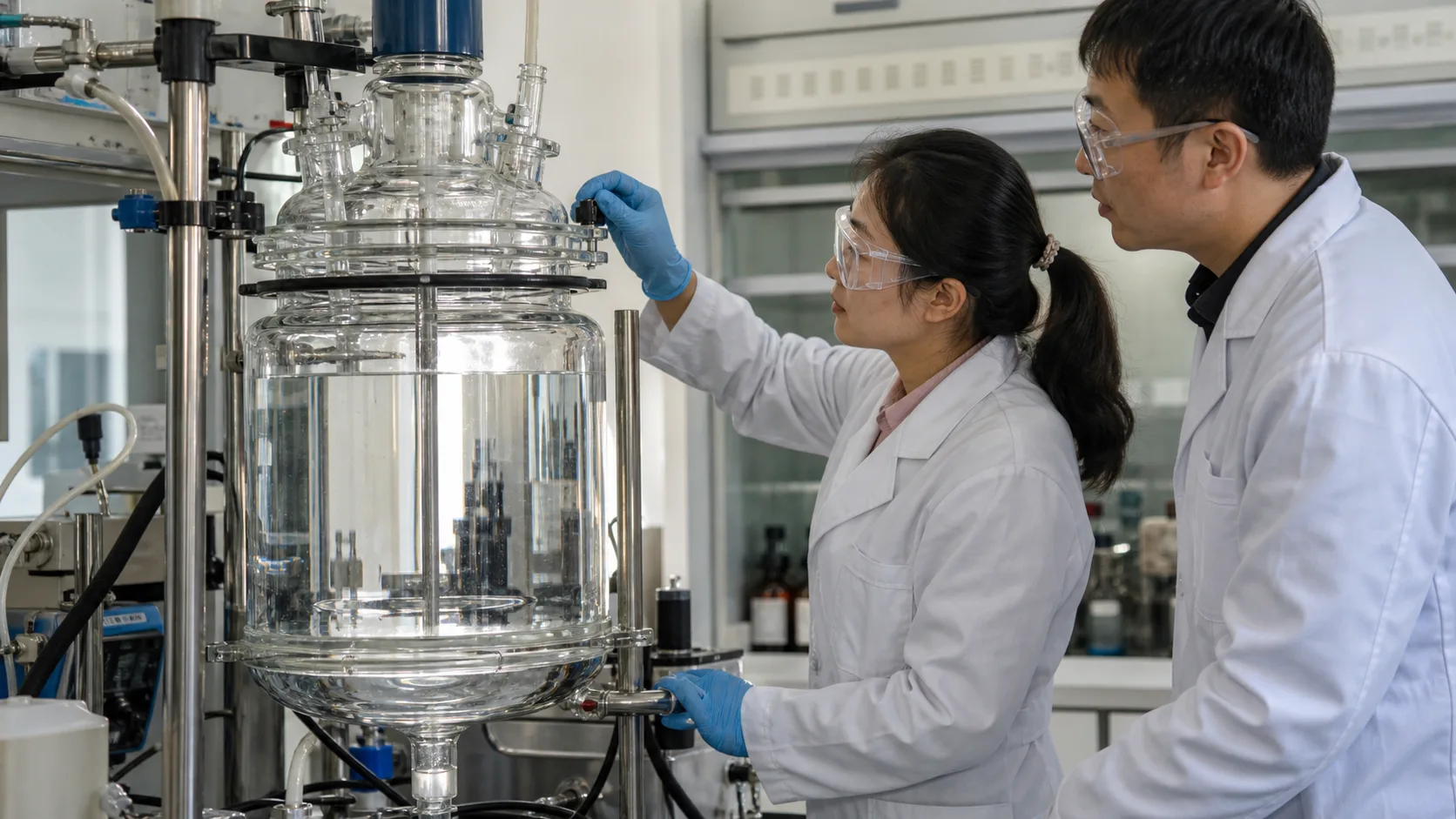
Laboratory staff examining a glass reactor and resin test setup
First understand the role of resin in the system.
Polyaspartic coatings typically form by reacting a polyaspartic ester resin component with an aliphatic isocyanate hardener. Secondary amines on the resin provide reaction sites, while the resin also contributes to pigment/filler wetting, application viscosity and flexibility. A resin is not a finished coating that can be assessed independently of its hardener; interpret every parameter within the complete two-component system.
Compared with conventional fast-spray polyurea, polyaspartic reaction rates are more readily adjusted through resin structure, hardener type, temperature and formulation, supporting rolling, brushing, troweling or spraying. A slower reaction does not remove the need for accurate metering, mixing and environmental control.
How the structure affects the speed of response
Steric hindrance around the secondary amine affects how readily isocyanate groups approach and react. Greater hindrance generally gives longer pot life at room temperature; less hindrance or higher system temperature can accelerate viscosity rise and gelation. Formulation design must balance working time, early cure, low-temperature reaction and final hardness.
Resin molecular weight, functionality and backbone flexibility affect the crosslinked network. Assess hardness and flexibility together with hardener functionality, NCO content, pigment and filler volume fraction, and the actual NCO/NH equivalent ratio.
The meaning of high entropy and low viscosity.
Lower viscosity assists pigment wetting, leveling and application in high-solids formulations, while higher solids reduce solvent use and increase film build. Low viscosity does not allow unlimited powder addition: unsuitable oil absorption, thixotropic additives or filler grading can still cause color floating, settling, craters or difficult application.
During development, record resin viscosity at different temperatures and test at the actual pigment-to-binder ratio and shear conditions. A single supplier viscosity value often cannot predict production, site mixing or thick-film behavior.
From reaction to varnish formation.
After A and B are mixed, the system passes through uniform mixing, viscosity rise, gelation, touch dry, pedestrian readiness and full cure. Each stage has different application and curing requirements. A non-tacky surface does not mean internal crosslinking is complete; premature immersion, heavy loading or chemical testing can give misleading results.
Moisture, amine contamination, residual solvents and entrained air can disrupt film formation. Condensation may reduce interface adhesion, and excessive shear can introduce bubbles. Dry tools, accurate weighing, low-speed mixing and an appropriate dew-point margin are needed to realize the resin's performance consistently.
Establishing the right evaluation methodology
Review amine value or equivalent weight, solids content, viscosity, color, density and recommended hardener, then test the intended formulation under target conditions. Assess pot life, touch-dry and through-dry times, adhesion, hardness development, elongation, abrasion resistance, weatherability and the recoat window.
Results from different standards, thicknesses, substrates and curing conditions are not directly comparable. Review the method alongside each result, first confirming suitability for the actual application before comparing individual performance values.