
Evaluating resins for yellowing resistance and outdoor weathering
Distinguish initial color, yellowing, gloss loss, chalking and coating aging, and understand the combined influence of resin, hardener, pigments and stabilizers on outdoor performance.
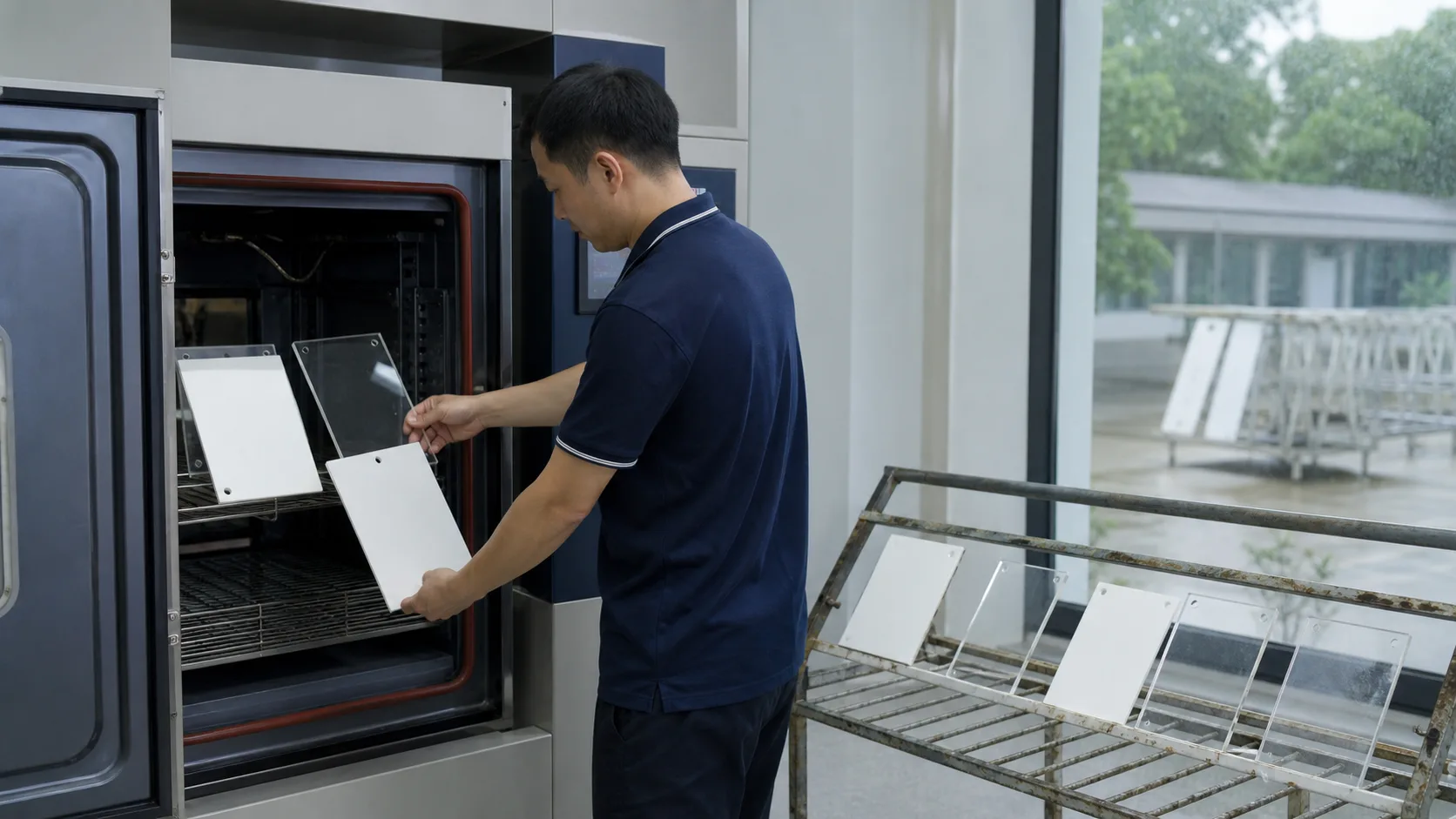
A technician recording sample tests beside a weathering chamber
Let's start with a few concepts.
Initial color describes the starting appearance; yellowing describes color change over time. Weathering also includes gloss loss, chalking, cracking, adhesion loss and mechanical deterioration. Clear, white and dark coatings reveal these changes differently, so choose criteria appropriate to the application.
Any grade-zero yellowing claim must identify the test method, duration, light source, film thickness and assessment criteria. A claim without test conditions cannot replace technical data.
Resin and Hardener
Polyaspartic resins are an important basis for weather-resistant systems, but hardener structure is equally important. Aromatic isocyanates or incompatible components can cause rapid outdoor discoloration even when the resin has low initial color.
Raw-material purity, residual amines, storage oxidation and high-temperature processing can affect color. Control color variation from raw materials through finished light-colored products.
Painting and stabilization aids
Inorganic pigments, some high-performance organic pigments and suitable UV absorbers and hindered-amine light stabilizers can improve color and gloss retention. However, additives may compete in absorption, migrate or cause compatibility problems. Higher dosage is not automatically better.
During development, assess which component contains the stabilizer, its dissolution and long-term storage stability, and verify performance through aging tests of the complete formulation.
How to design a weathering test
Xenon-arc or QUV accelerated weathering is useful for screening and relative comparison. Record irradiance, spray, condensation, black-panel temperature and cycle conditions. Test hours cannot simply be converted directly into years outdoors.
For critical projects, combine natural exposure, realistic contamination and cleaning, and recoating trials, monitoring color change, gloss retention, chalking, cracking and adhesion.
Construction also affects appearance life.
Insufficient thickness, uneven mixing, pinholes, substrate contamination and premature water exposure reduce outdoor durability. Color batches, roller direction and overlaps also affect initial appearance.
A weathering specification should define materials, layers, thickness, application windows and maintenance intervals together, rather than naming only a resin.