
Waterproof paint construction programme and alternative proposal
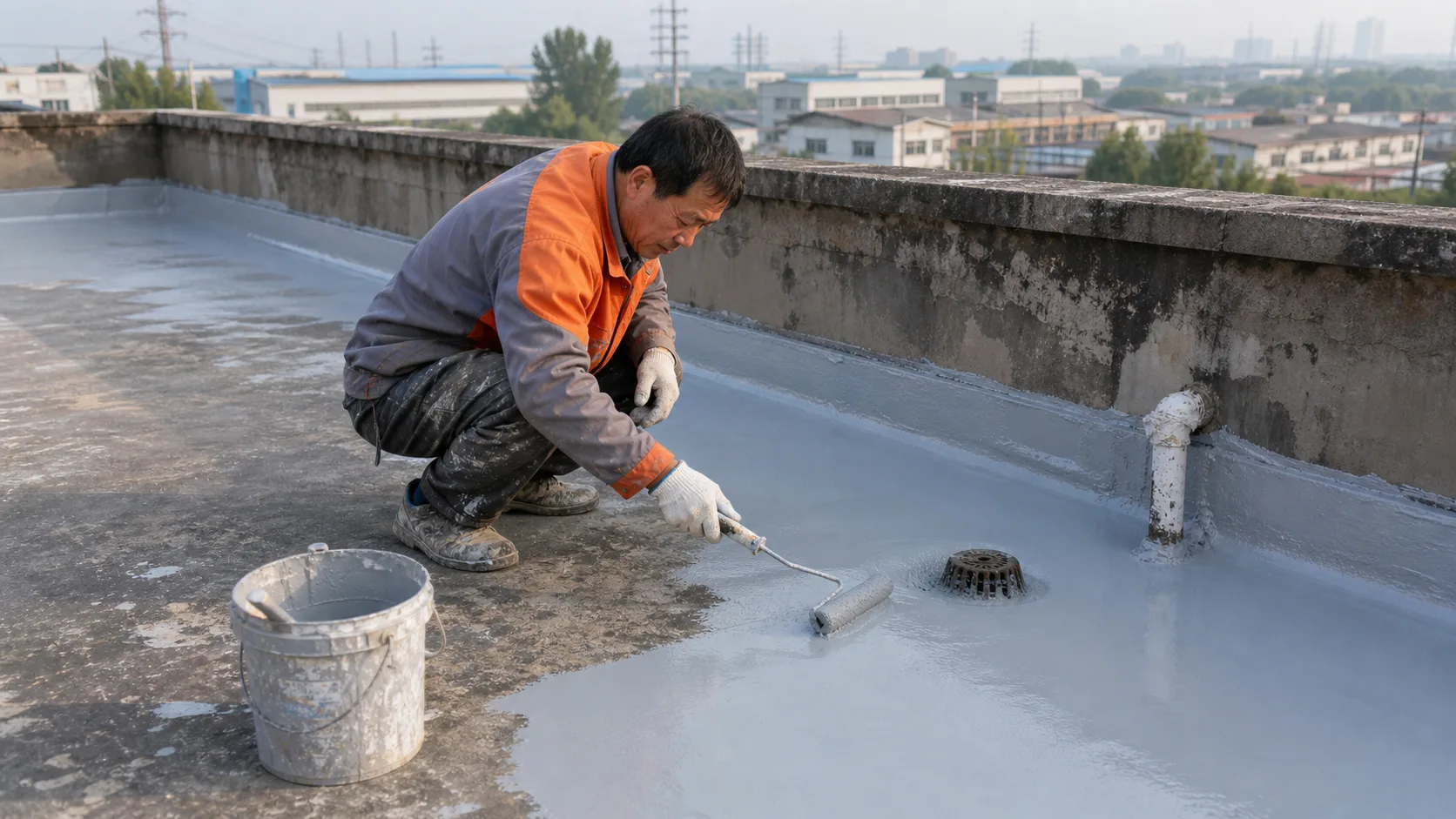
Illustration showing roof waterproofing work, tools and coating layers
I. Preamble
Polyaspartic polyureaWaterproof coatingsSelect the coating system according to the actual substrate, exposure, application conditions and acceptance criteria. Junaimei provides product information and technical support to help evaluate suitable options.
II. Substrate processing requirements
2.1 concrete substrate
- Water content: ≤3% (tested with water content tester)
- Strength: ≥C25; surface pull-off strength: ≥5MPa
- Flatness: 2m rectangular check, gap ≤3mm
- Cleanness: no oil, no ash, no loose matter
2.2 Metal substrate
- Rusting grade: Sa2.5 class (spray treatment)
- Surface roughness: Rz40-70μm
- Cleanness: no oil, no water, no dust
III. Construction process
3.1 primer Construction
Materials:A compatible primer for the polyaspartic system, selected for the substrate and main coating.
Usage:Follow the selected primer documentation. Page 2 of the roof waterproofing TDS gives a reference coverage of 7 m²/L for its specified primer; this cannot be converted into a universal kg/m² application rate for all primers.
Methodology:Roll or brush, evenly covered
Dry time:Follow the specified system. Page 2 of the roof waterproofing TDS requires the dedicated primer to cure for 24 h before applying the main roof coating.
Painting in 3.2
Materials:Select a polyaspartic waterproofing coating for the intended use; see Section 4 for systems and application conditions.
Usage:Calculate consumption from the selected product TDS, substrate condition and specified film thickness, distinguishing theoretical coverage from application losses.
Methodology:Rolling, brushing or scratching, cross-cutting construction
thickness:Control dry or wet film thickness for the specific system. Do not apply one thickness value to roofs, basements, wet areas and pools alike; see Section 4.
Recoating interval:Follow the product TDS: at 25°C, the roof waterproofing coating requires at least 8 h between coats, while the clear kitchen and bathroom coating requires 24 h. Touch-dry does not mean ready for recoating.
3.3 Enhanced Layer Construction (optional)
At vulnerable details such as cracks, pipe penetrations and internal or external corners, reinforce with polyester fabric or fiberglass fabric to improve the waterproofing layer's crack resistance.
3.4 coating works (optional)
For outdoors or decorative scenes, a polyaspartic polyurea coating can be constructed to improve the value of the decoration.
IV. Recommendations for product selection
4.1 Waterproof house
Recommended products:Polyaspartic Roof Waterproofing Coating。
Construction thickness:The current roof TDS does not specify a universal dry or wet film thickness for the main coating. Confirm total thickness and consumption per coat for the model and project. It specifies 2–3 coats and at least 8 h between coats at 25°C; coat count does not replace film-thickness acceptance. See Roof Waterproofing TDS, page 2。
Characteristics:For the exposed roof substrates listed in the documentation. Check primer compatibility, joint sealing, substrate condition and curing requirements before application.
4.2 Waterproof basement
Recommended products:Basement Waterproofing System, selected for the actual conditions, such as wall repairs, positive-side or negative-side waterproofing.
Construction thickness:For basement wall repairs using the handbook's clear wall waterproofing system, the reference thickness is 0.2–0.5 mm per application; the document does not identify this as dry or wet film thickness. It is not the total design thickness for basement waterproofing. Confirm the system, total thickness and detailing separately for water pressure or continuing leaks. See System Application Handbook, pages 9–11。
Characteristics:The clear wall system is for wall maintenance within its stated application conditions. Damp substrates, persistent leaks or water pressure require technical assessment and substrate treatment first.
4.3 Waterproof bathroom
Recommended products:Clear Polyaspartic Kitchen and Bathroom Waterproofing Coating (Tile-Preserving System)。
Construction thickness:For flat tiled surfaces: DFT 200–300 μm and WFT 200–300 μm, equivalent to 0.2–0.3 mm. These values apply only to flat-surface application of this clear wet-area repair product. Confirm total coat count and flood-testing requirements in the project specification. See Clear Kitchen and Bathroom Waterproofing TDS, page 1 and System Application Handbook, page 7。
Characteristics:For clear waterproofing repairs over existing kitchen and bathroom tiles. Remove wax, clean and dry the substrate, and prepare the interface as specified in the TDS.
4.4 Waterproof pool
Recommended products:Polyaspartic Pool and Dam Waterproofing System; confirm the specific model for the pool substrate, immersion conditions and water pressure.
Construction thickness:The linked general system handbook does not specify the design film thickness for a dedicated pool system. Obtain the model-specific TDS or a written technical specification covering total dry film thickness, consumption per coat, coat count, recoating intervals and curing before filling. Do not substitute thickness values for clear wet-area waterproofing or wall repairs.
Characteristics:Confirm prolonged immersion, exposure media and water-pressure conditions individually. For contact with drinking water, also verify product-specific evidence of suitability.
Quality acceptance standards
- Gravity of coating: meeting design requirements, allowing deviation ≤10%
- adhesion: ≥2.5MPa (concrete concrete), ≥2.5MPa (metal substrate)
- Closed water test: 48 hour no leakage
- Appearance: even coating, no bubbles, no cracks, no stripes
VI. Construction care
- Construction temperature: 5℃ - 40℃, relative humidity ≤85%
- Substrate temperature above dew point temperature 3℃
- Do not apply in rain, snow or fog.
- The mixed materials should be exhausted in 30 minutes
- After construction 24 Avoid rain or tread within hours
Concluding remarks
Select the coating system according to the actual substrate, exposure, application conditions and acceptance criteria. Junaimei provides product information and technical support to help evaluate suitable options.