
Industrial Corrosion Protection: Environment & System Selection
Select systems for industrial equipment and steel structures by assessing corrosive media, steel preparation, compatible primer/intermediate/topcoat layers and recoating requirements.
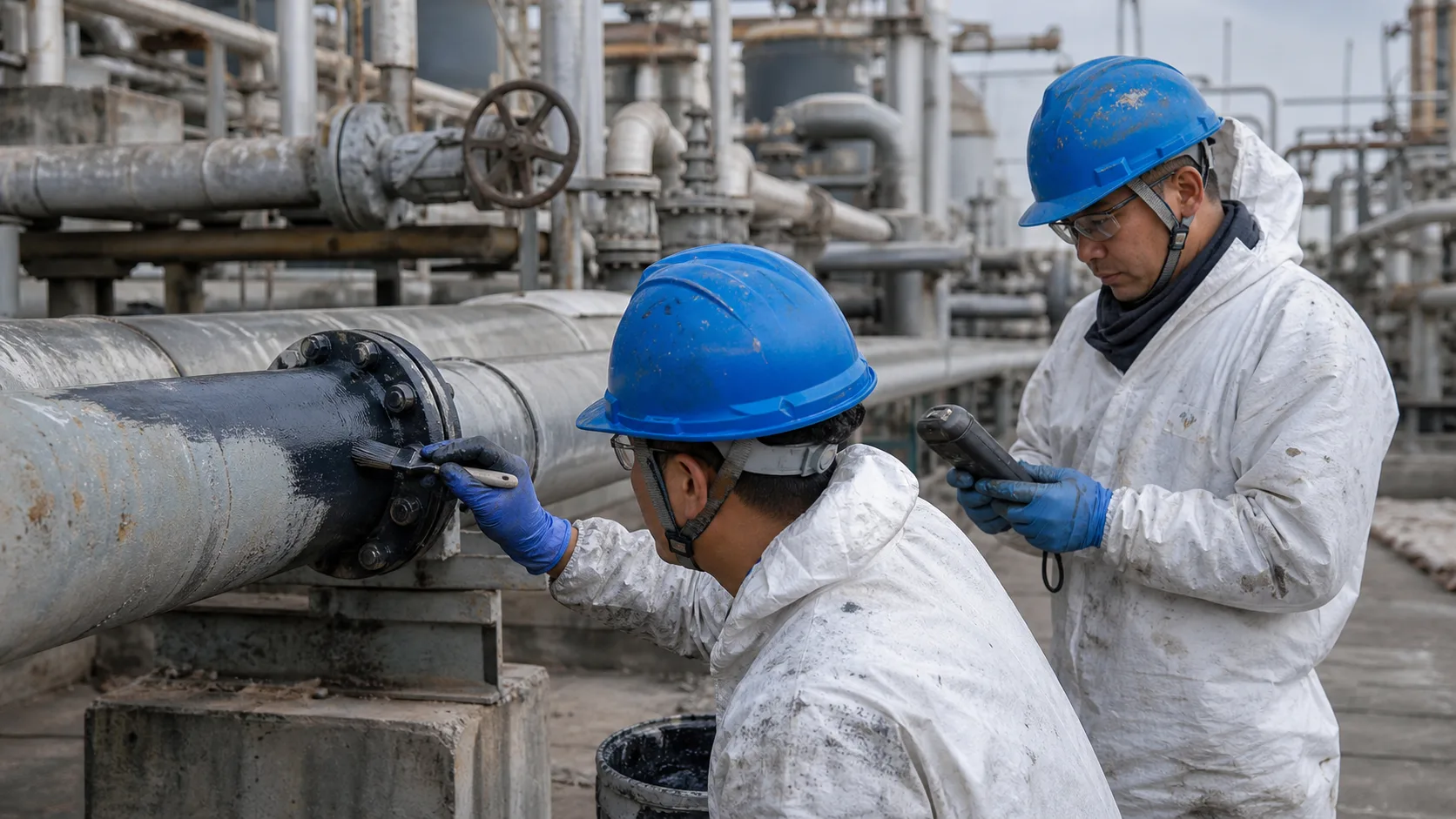
Workers applying and inspecting a coating on industrial pipework
Identification of real corrosive conditions
Define exposure to salt spray, acids, alkalis, solvents, heat, humidity, UV and temperature cycling, and distinguish splashing, intermittent contact and continuous immersion. A general claim of acid and alkali resistance is insufficient for reliable selection.
Steel structure surface treatment
Thoroughly remove grease, rust, mill scale and failed coatings. After blasting or grinding, remove dust and promptly apply the compatible primer to prevent renewed oxidation or moisture exposure.
Stripe-coat welds, sharp edges, bolts, holes and areas that are difficult to cover before applying the full coat.
Bottom topcoat synergies
The primer provides adhesion and rust protection, the intermediate layer provides barrier thickness, and the polyaspartic topcoat provides weathering and abrasion resistance plus an additional chemical barrier. Do not mix brands or curing systems without compatibility testing.
Inspection and maintenance
Check wet and dry film thickness, holidays, pinholes and intercoat condition during application. In service, set inspection intervals around chemical exposure, cleaning frequency and mechanical damage. Repair local defects promptly to prevent underfilm corrosion.
Corrosion survey and system design
Begin corrosion-protection design by defining measurable exposure conditions: media and concentration, temperature, contact frequency, immersion or splash, cleaning, UV exposure, condensation and mechanical wear. Steel in dry indoor areas, outdoor atmospheres and beneath insulation can fail differently. Use corrosion history, shutdown windows and maintainability to define zones, then specify primer adhesion and rust protection, intermediate barrier thickness and topcoat weathering, abrasion or chemical resistance.
Compare material data under relevant test conditions. Salt-spray hours, immersion results and adhesion values are meaningful only when the substrate, preparation, film thickness, curing time and assessment method are comparable. For continuous immersion, strong solvents, high temperatures or thermal cycling, conduct application-specific trials or chemical compatibility tests first. Polyaspartic coatings can provide fast curing and weather-resistant topcoats, but one formulation cannot be assumed suitable for every chemical environment. Base the final system on product technical data, project testing and a written technical agreement.
Surface treatment and coating tissue
Steel surface preparation places an upper limit on the durability of a corrosion-protection system. Remove grease, salts, weld slag, spatter, sharp edges and failed paint, then blast-clean or mechanically prepare the surface to the specified cleanliness and profile. Prevent recontamination by handling, rain or dust and apply primer before rust returns. Welds, bolts, edges, rear faces and confined areas tend to have low film thickness; stripe-coat these areas before full application. Repairing existing coatings also requires compatibility and adhesion tests: new and old materials are not automatically compatible.
Plan site work around pot life and the recoat window. Use calibrated scales, premix each component and combine them at the specified ratio with low-speed mixing. Scrape material from the sides and bottom of the container into the mix to avoid local ratio errors. Choose spraying, rolling or brushing according to component geometry, target thickness and site restrictions. Record wet-film thickness, consumption and appearance for every coat, and recoat only when the specified condition is reached. If the recoat window is exceeded, clean and abrade as required to restore a mechanical key. Do not coat over dust, condensation or an insufficiently cured surface.
Quality testing and life-long management
Acceptance covers surface-preparation records, environmental conditions, dry film thickness, holidays, pinholes, adhesion and appearance. Plan measurement points by component and area, with extra attention to edges and welds. Calibrate instruments before and after use and retain raw data. Where required, holiday testing of tank or pipe linings and immersion areas must use voltage, probes and cure conditions appropriate to the coating. Mark defects, identify the affected layer, and repair in layers back to sound edges.
Maintenance should begin before widespread corrosion develops. Keep component IDs, initial photographs, film-thickness maps, exposure conditions and repair history, and schedule quarterly or annual inspections according to corrosion risk. Pay particular attention to areas retaining water, insulation interfaces, supports, bolts, welds and impact-prone locations. Promptly repair scratches and rust spots to limit underfilm corrosion and reduce shutdown areas. Reassess the system if cleaning agents, disinfectants or process chemicals change.
Project landing and risk review
Before work begins, the project lead should review site conditions with the designer, material supplier, applicator and owner, converting drawing requirements into an actionable area checklist. Include substrate type and condition, coating layers and thicknesses, details, material batches, mixing quantities, tools, crew responsibilities, environmental controls, recoat times and return-to-service conditions. Coordinate other trades, temporary power, ventilation, fire precautions and protection of completed work so that welding, cutting, dust and equipment installation do not interfere with coating. Inspect the first completed area and compare consumption and cure with the trial area before continuing at scale.
Use inspection hold points throughout the work instead of waiting until all surfaces are covered. Inspect and retain photographs and data after substrate preparation, primer sealing, defect repair, reinforcement of critical details and before final handover. If material condition, environmental limits, batch changes or widespread defects raise concerns, isolate the area, retain samples and records, and obtain a technical assessment. Every rework record should identify the failed interface, repair area, materials and retest results. Trial areas, witnessed process checks, traceable records and verified repairs help translate laboratory performance into reliable field performance.