
14. Junaimei polyaspartic matte topcoats: low-gloss surface protection
1. Matte topcoats address surface-gloss requirements
Junaimei polyaspartic matte topcoats can be considered in relation to low-gloss appearance, surface protection and maintenance. Their visible aim is to reduce pronounced specular reflection for a softer appearance. Low-gloss design does not mean that the lowest possible gloss is right for every space.
The same panel can look different under different lighting. Broad grazing light, spotlights and daylight can reveal roller marks, overlaps and gloss variation. Assess finishes under representative conditions rather than choose from a phone photograph alone.
2. Define “matte” through comparable samples and measurements
Commercial terms such as matte, satin and soft sheen do not always have uniform boundaries. Agree on a reference panel, measurement method and permitted variation. Instrument readings require comparable angles, surface states and specimen conditions.
A specification stating only “matte effect” can leave the parties with different expectations. Base color, texture and flatness particularly influence clear finishes. Prepare samples using the actual substrate, color and tools, and retain an agreed physical reference.
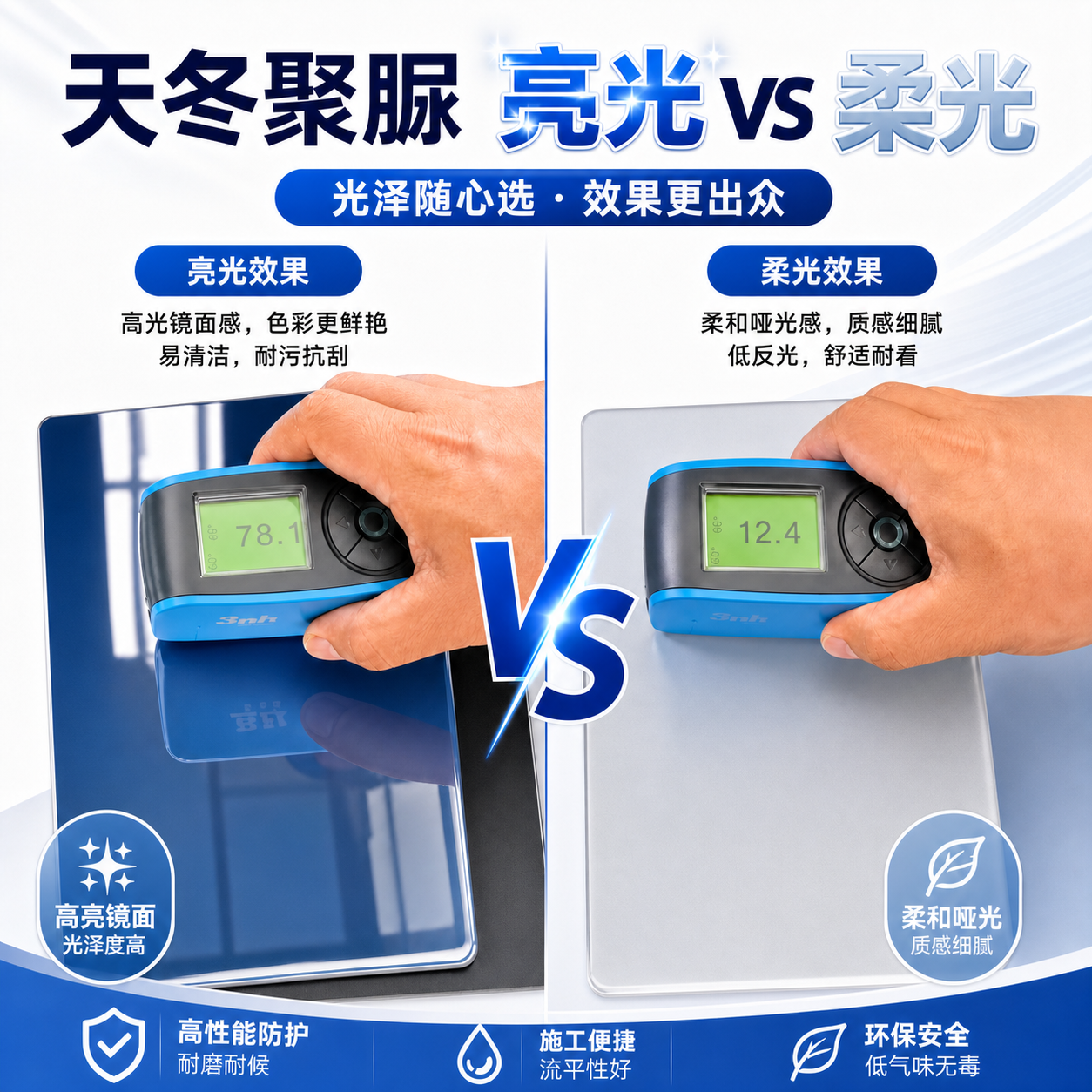
Glossy and soft-sheen surfaces can be compared through reflected-image clarity and pronounced highlights. Photographs are also influenced by lighting, viewing angle and exposure. Commercial descriptions overlap, so procurement should use the agreed measurement method and sample instead of treating image labels as universal grades.
3. Matte appearance requires formulation design
Gloss is related to microscopic surface shape. Matting agents and other formulation approaches change reflection, but can also affect viscosity, clarity, feel and cleaning. Matting a high-solids system requires control of particle dispersion and stability, not simply the addition of a powder.
BYK’s technical literature specifically discusses silica matting-agent dispersion in high-solids and solvent-free systems, illustrating the need to design dispersion, viscosity, stability and matting together. BYK on matting-agent dispersion in high-solids systems
4. Where matte finishes may be considered
Commercial spaces sensitive to pronounced reflections, decorative surfaces seeking a softer appearance and equipment requiring low gloss may consider matte polyaspartics. Suitability still depends on the grade, substrate and exposure.
Floor projects need traffic and cleaning evaluation; equipment needs assessment of oils, wiping and handling; exterior work needs color and gloss retention assessment. A finish intended for light-duty interior decoration should not automatically be transferred to heavy-duty exterior service.
5. Does matte automatically mean stain-resistant or slip-resistant?
No. Stain resistance depends on the contaminant, surface structure, formulation and cleaning. Slip resistance depends on footwear or contacting objects, wetness, contamination and texture. Low gloss describes an optical property, not tested service behavior.
A matte sample that feels acceptable when dry may behave differently with water or oil. Floor specifications should identify wet or contaminated conditions and assess them using a suitable method. Walls and equipment require attention to shiny patches, color changes and damage after wiping.
6. Application details that need control
Where a formulation contains settling components, premix thoroughly as instructed to make the container uniform. Published guidance for other brands also identifies matting-agent settling and premixing as important; its ratios and environmental limits are not instructions for Junaimei products. Example application guidance for a matte polyaspartic coating
Maintain consistent consumption, tools, finishing direction and wet-edge timing. Repeated local rolling, large differences in elapsed mixing time and excessive build can produce uneven appearance. Establish the method on a trial area before coating the main surface.
7. Check clarity in clear matte finishes
A clear matte finish may aim to protect the base color while reducing reflection. Matting level, film thickness and underlying patterns can change transparency. Slight haze visible over a dark base may be inconspicuous over a light one, so one pale sample does not establish performance across all colors.
Over flakes, decorative floors or stone effects, examine pattern definition, color saturation and overlaps. Very low gloss may not preserve a desired rich or “wet” appearance. The appropriate gloss level matters more than pursuing maximum matting.
8. Purchase a defined Junaimei grade
When discussing a Junaimei polyaspartic matte topcoat, provide the substrate, existing coating, color, indoor or outdoor exposure, whether it is a floor, likely contaminants and planned opening time. The supplier can then identify a grade and system for sample and acceptance discussions.
Confirm gloss measurement conditions, mixing ratio, recoat window, return-to-service requirements and relevant performance. Use the agreed sample to define the final appearance.